Features · Closures & Parts

Closures, Valves & Parts — What Each One Is Actually Hired to Do

A closure is not a line item on a quote — it is the moment three weeks after opening when your customer finds out whether the product is still good. Here is every part we weld into pouches, what job it does, what it costs, and when to skip it.

Every part, hired for a job

You don't buy a zipper — you buy the moment your customer reseals the bag and the product is still fresh. Each part below is priced, ruled, and honest about when to skip it.

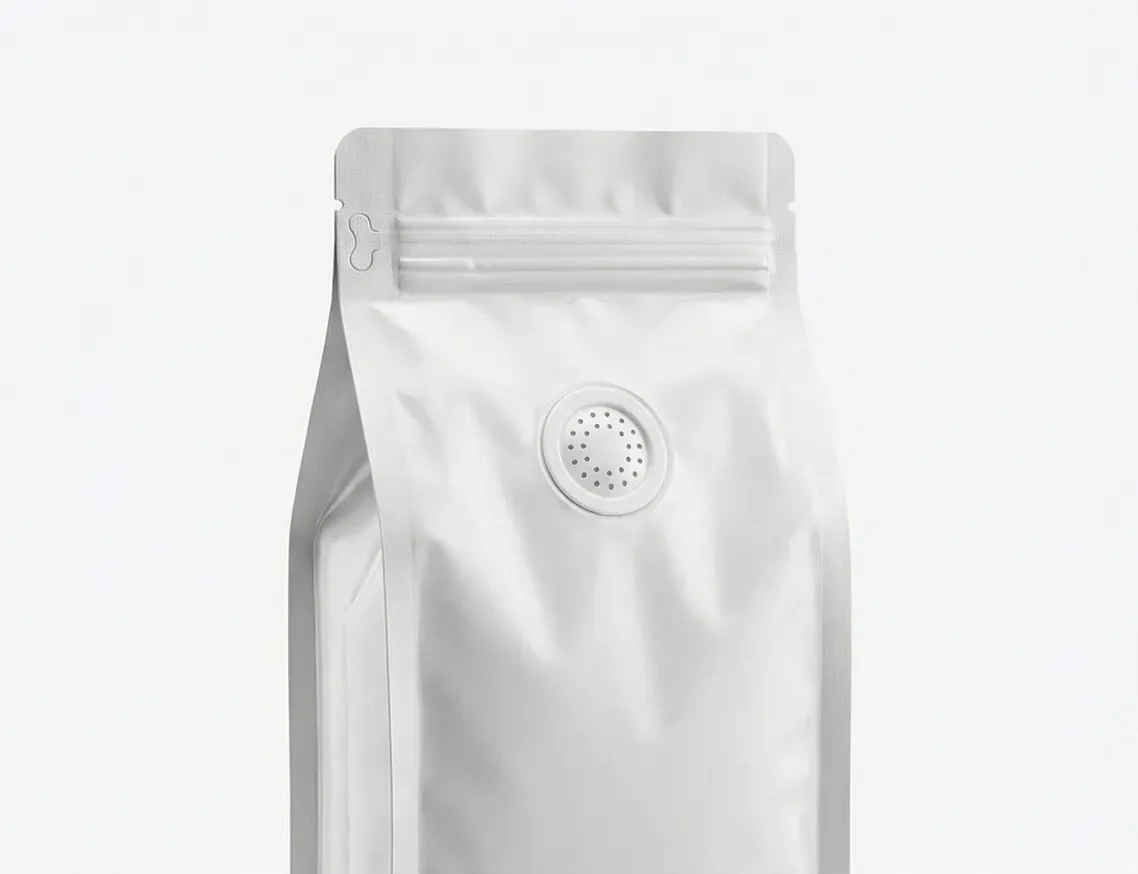
One-way degassing valve close-up on a coffee pouch
Click to enlarge
+$0.06–0.09 / pc

One-Way Degassing Valve

Lets CO₂ out, keeps O₂ away

The job it gets hired forFresh-roasted coffee keeps releasing CO₂ for days after roasting. Sealed without a valve, the bag balloons or bursts; left open, oxygen kills the roast. The valve is the one-way door that solves both.
Engineering rulePlaced 60–70mm from the top seal on a 250g format, always above the fill line. Welded inline during bag making — it cannot be added later.
Skip it if…Your product does not off-gas. A valve on a jerky bag is $0.09 spent on nothing — we will tell you that on the quote.
Certified compostable valve variants exist for compostable structures; standard PE valves suit recyclable mono-PE.
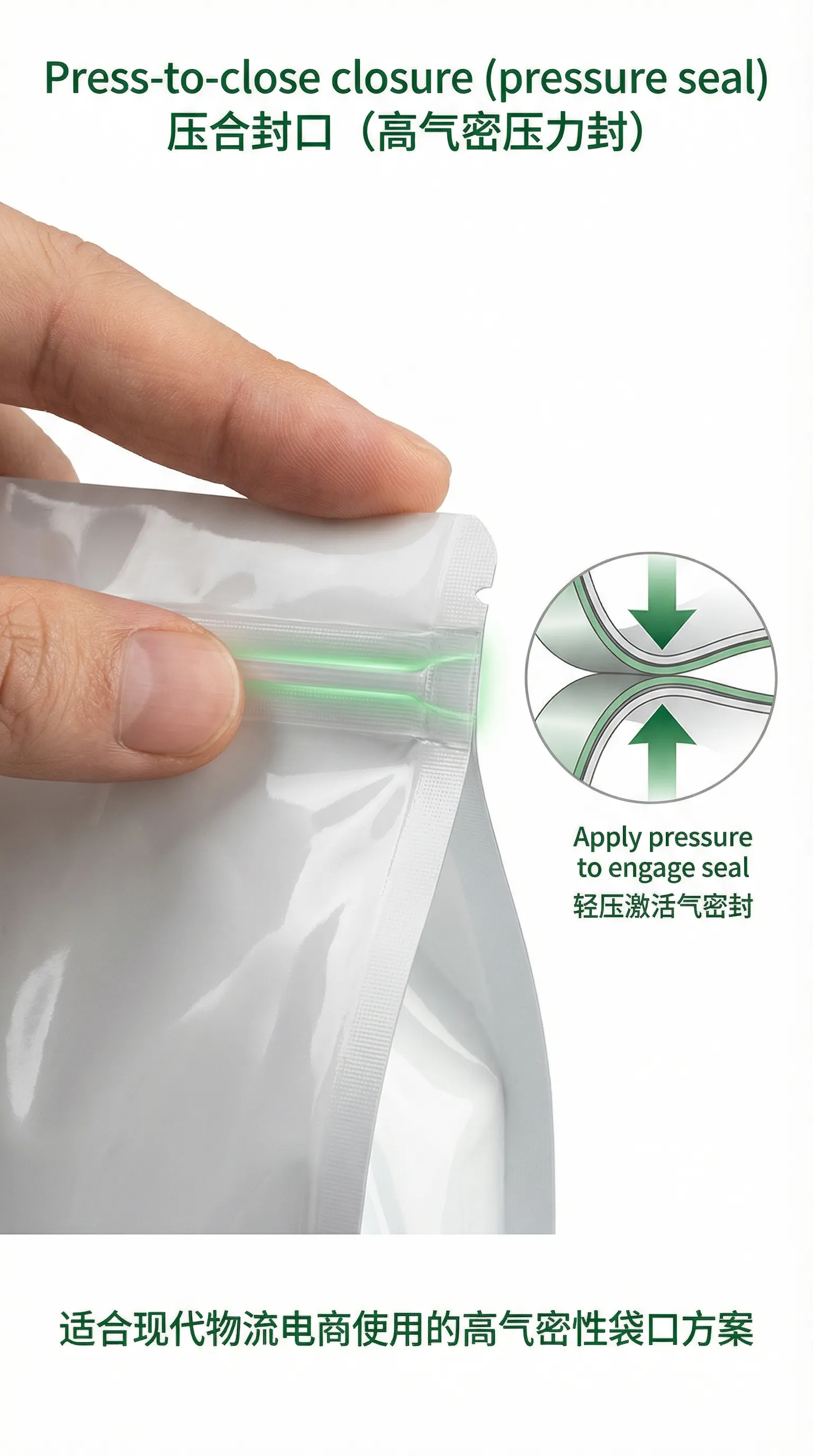
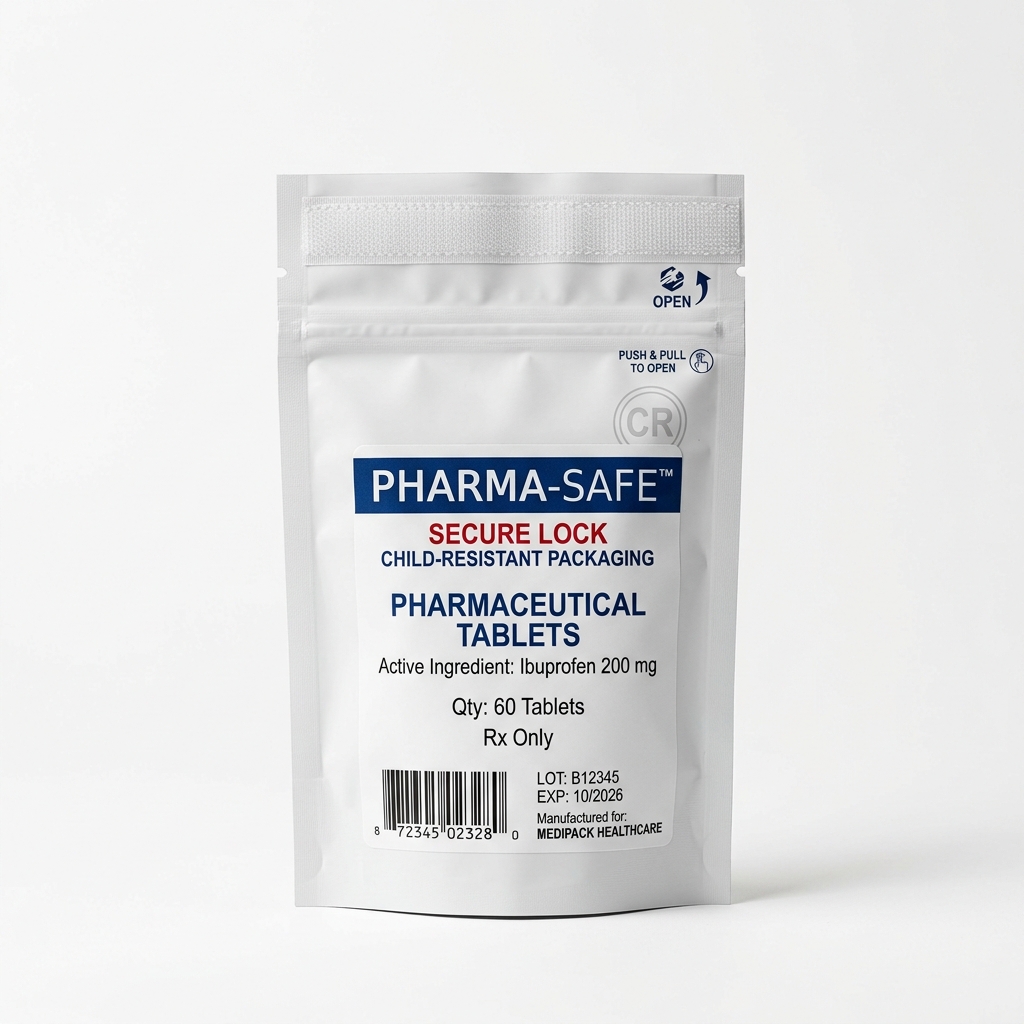
Press-to-close zipper detail on a stand-up pouch
Click to enlarge
+$0.03–0.06 / pc

Press-to-Close Zipper

The everyday reseal

The job it gets hired forSnacks, supplements, pet treats — anything opened daily and expected to stay fresh for weeks. The zip your customer presses shut without thinking is the reason the last serving tastes like the first.
Engineering ruleSits 15–20mm below the tear notch. Seal and zip are leak-tested together on every production run, not sampled.
Skip it if…The pouch is single-serve or consumed in one sitting. A zipper on a one-shot bag only adds cost and a failure point.
PLA zippers for certified compostable pouches; PE zippers keep mono-PE structures fully recyclable.
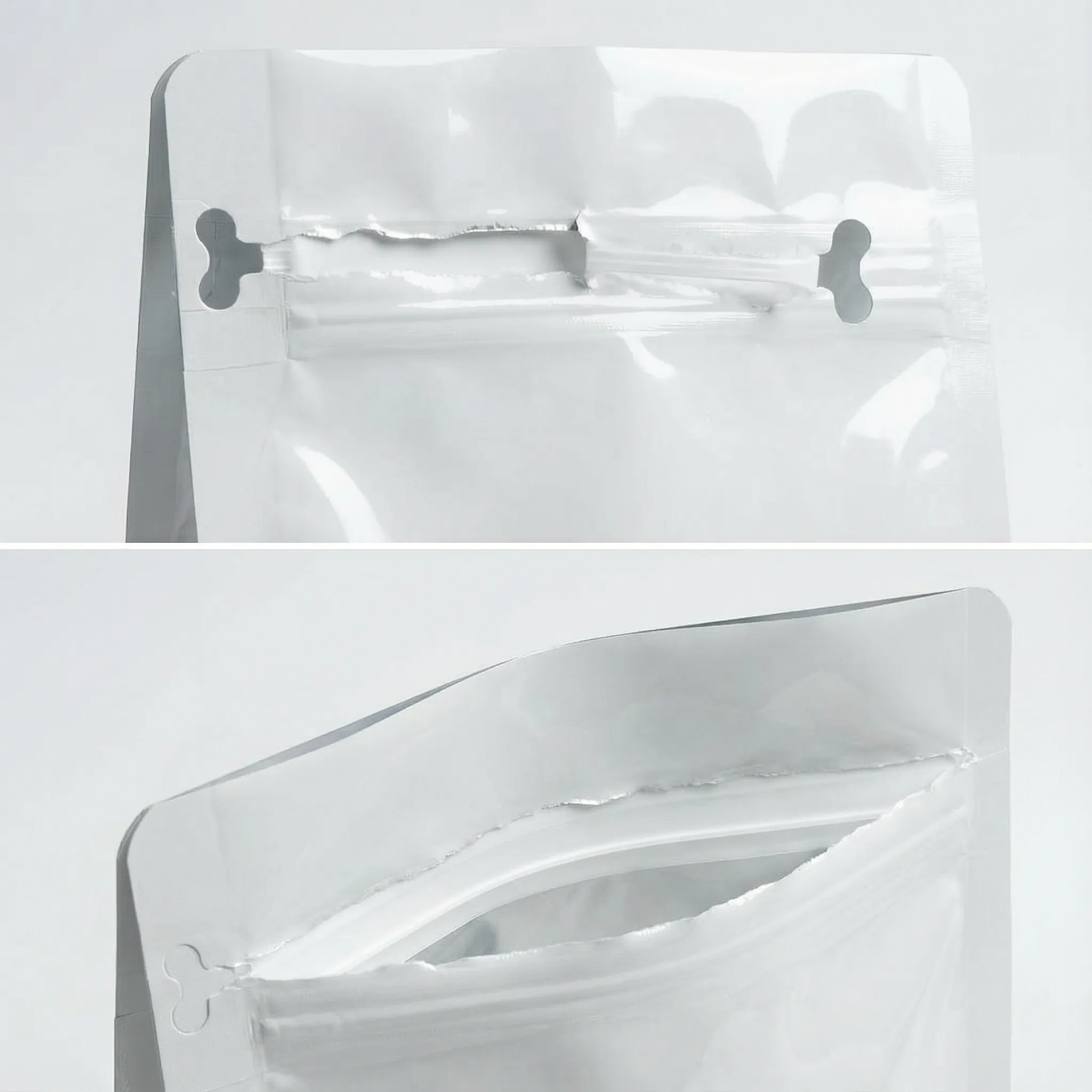
Front pocket zipper on a flat bottom pouch
Click to enlarge
+$0.09–0.15 / pc

Pocket Zip (Front Zipper)

The premium easy-open

The job it gets hired forBrands that want the bag opened from the front face without scissors or tearing across the top. Flat-bottom coffee and premium snack bags use it — the opening feels deliberate, like a box.
Engineering ruleWorks best on flat-bottom and box pouches where the front panel is structural. Adds one more weld step — confirm dieline early.
Skip it if…Your pouch is a simple stand-up under 500g — a standard top zip does the same job for a third of the cost.
Available in PE for recyclable structures; no certified compostable front-zip yet — compostable builds use top zips.
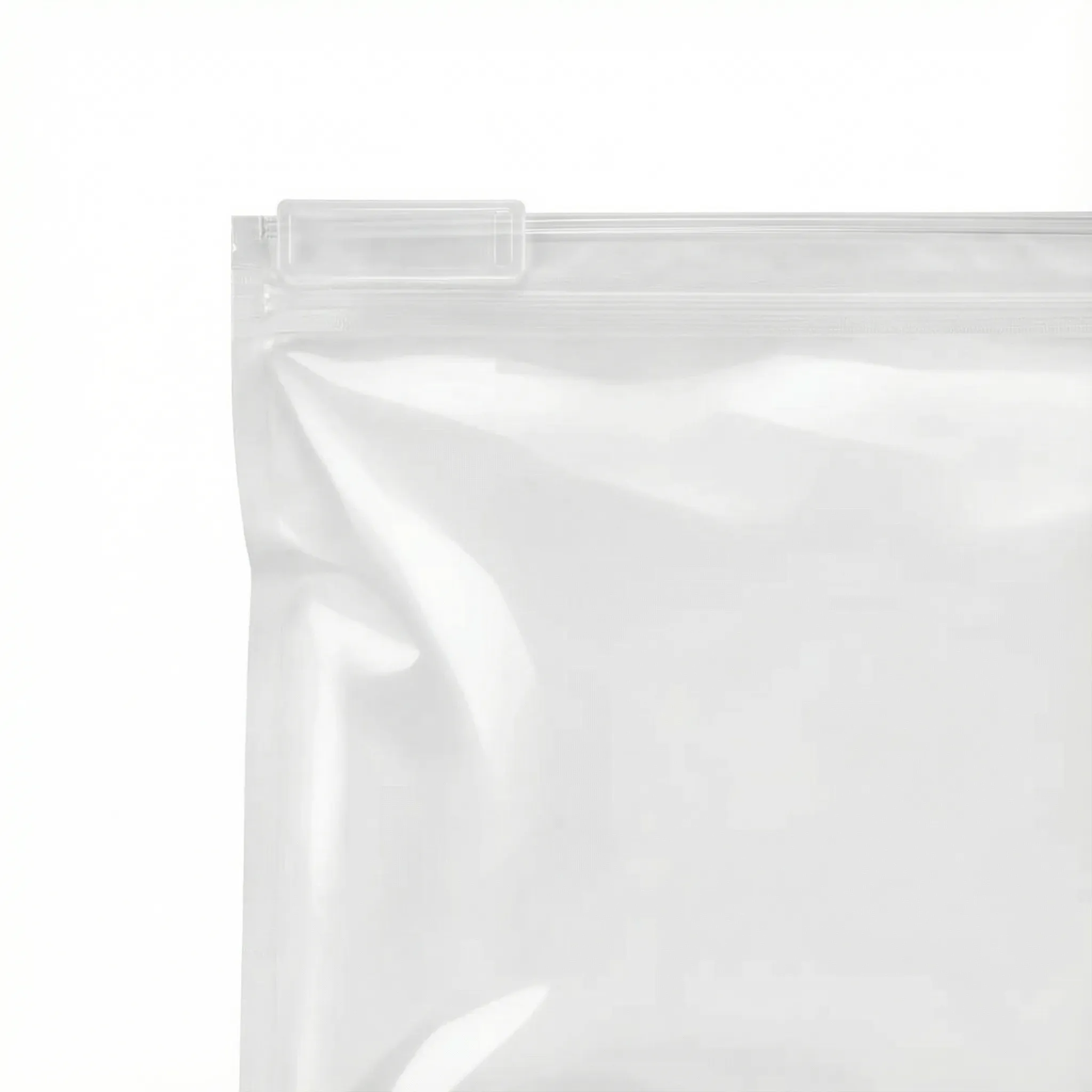
Slider zipper on a pouch
Click to enlarge
+$0.09–0.15 / pc

Slider Zipper

One-hand open, impossible to half-close

The job it gets hired forFrozen food, shredded cheese, big pet-food bags — products used with one wet or busy hand. The slider forces a full close; there is no "thought I pressed it" failure mode.
Engineering ruleNeeds a reinforced header; budget an extra 15mm of top space on the dieline. End-stops are ultrasonically welded.
Skip it if…Your pouch is under 250g or your customer decants into a jar anyway — press-to-close is cheaper and simpler.
PE sliders compatible with mono-PE recyclable structures; check compostable availability per project.
Velcro hook-and-loop closure on a heavy-duty pouch
Click to enlarge
+$0.12–0.18 / pc

Velcro (Hook & Loop)

The heavy-bag, powder-proof closure

The job it gets hired forBags over 1kg, and anything powdery — protein powder, flour, supplements. Zipper tracks jam with fine dust; hook-and-loop does not care. Also the only closure that survives being opened with scoop in hand.
Engineering ruleRequires a reinforced header — add 20mm. Both strips are welded full-width; we burst-test to 3kg internal pressure.
Skip it if…Your bag is under 700g. Velcro on a light bag is paying premium for a problem a zipper does not have.
Nylon-based — it is the one closure that breaks a mono-material story. Flag it on recyclable claims.
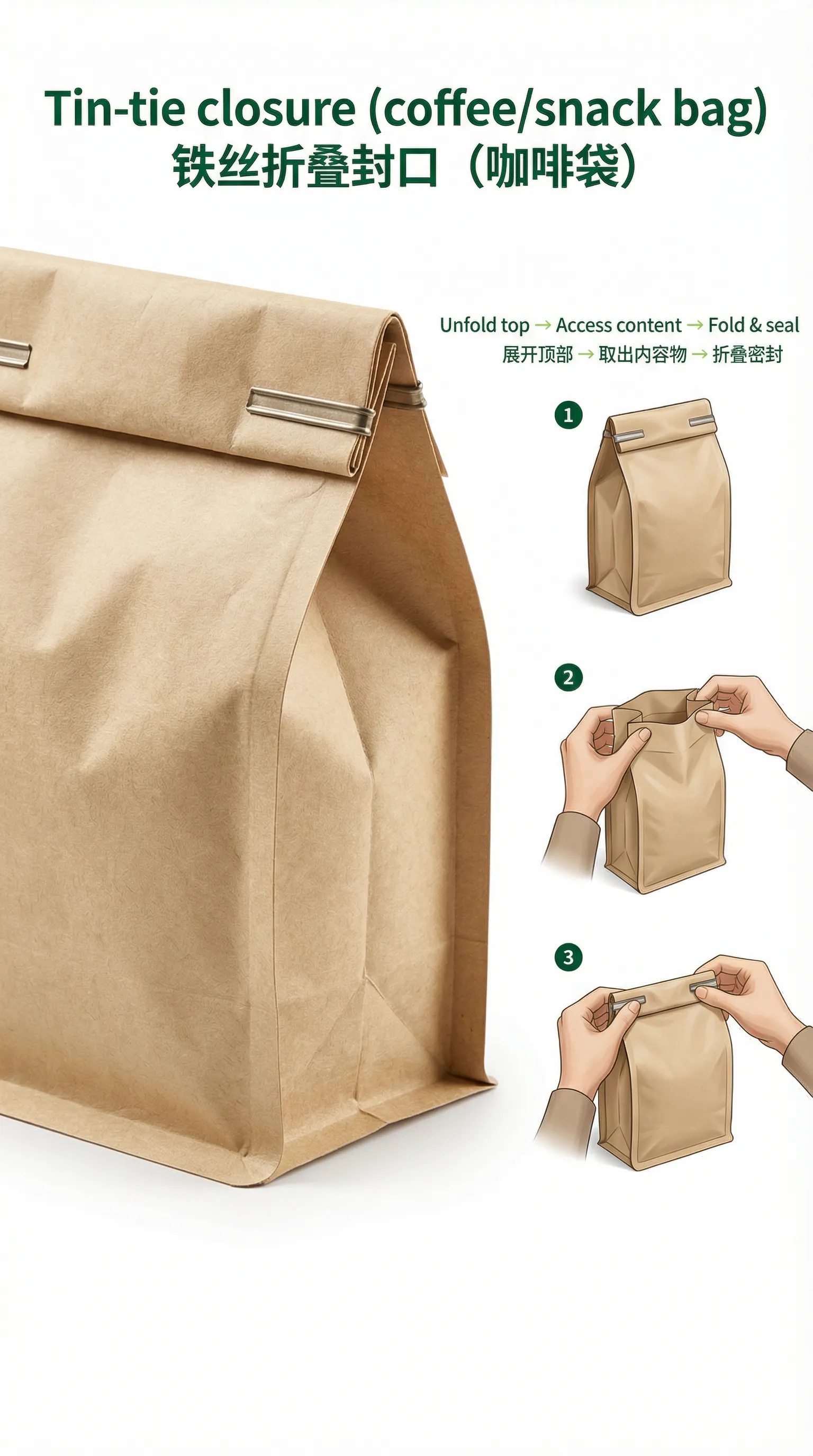
Tin tie closure on a kraft coffee pouch
Click to enlarge
+$0.06–0.12 / pc

Tin Tie

Ritual, not barrier

The job it gets hired forThe café-shelf ritual: fold, roll, clip. Customers associate it with craft coffee and bakery. It signals "fresh from the roaster" better than any zip.
Engineering ruleAdhesive-applied to the back panel above the fill line. Pair with a valve for coffee — the tie closes the top, the valve handles the gas.
Skip it if…You need actual oxygen barrier after opening. A rolled tin tie is ceremony, not a hermetic seal — we say this on every coffee quote.
Kraft/paper-covered ties suit compostable kraft builds; the adhesive strip is the limiting element.
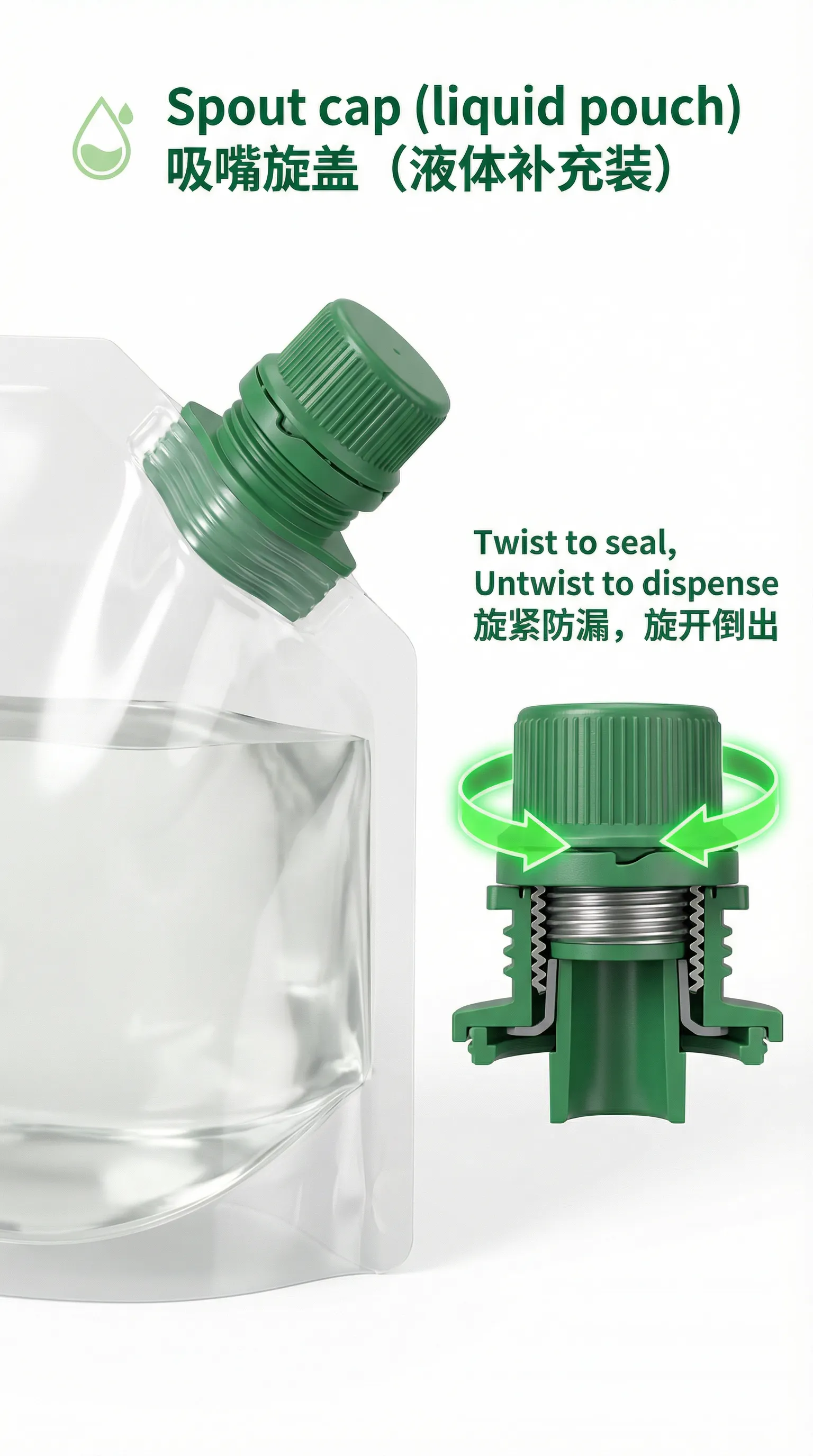
Spout and cap closure close-up
Click to enlarge
+$0.15–0.27 / pc

Spout & Cap

Controlled pour for liquids

The job it gets hired forLiquids, purees, sauces, oils — anything poured. The spout turns a pouch into a bottle: controlled flow, resealable cap, no mess down the side.
Engineering ruleFitment is heat-welded through all film layers; every run passes a 3kg internal-pressure leak test. Cap size (8.6mm / 10mm / 16mm+) matched to viscosity.
Skip it if…Your product is dry. And for baby food, spec the anti-choke cap — it is a different part, not an option.
PE spouts keep mono-PE pouches recyclable; spout is usually the part removed before recycling — we note it on-pack.
Laser-scored easy-tear line on a pouch
Click to enlarge
+$0.03–0.06 / pc

Laser Scoring (Easy Tear)

A clean straight tear, every time

The job it gets hired forThe first-open experience. A laser-scored line tears dead straight with no scissors and no jagged edge — the difference between "premium" and "fought with the bag" happens in two seconds.
Engineering ruleScored on the outer layer only, depth-calibrated per structure. Placed above the zipper so the tear strips the seal, not the zip.
Skip it if…Your pouch is kraft paper-faced — paper tears clean by itself. Laser scoring earns its cost on film structures.
No added material — pure process upgrade. Works on compostable, recyclable and conventional films alike.

The matrix we use in production meetings

Your productClosureValve?Why
Coffee 250g–1kgTin tie or pocket zipYes — alwaysCO₂ off-gassing; ritual or premium open
Snacks & nutsPress-to-close zipperNoDaily reseal; no off-gassing
Protein powder 1kg+VelcroNoPowder jams zip tracks; heavy bag
Pet food 2kg+SliderNoOne-hand use; forced full close
Sauces & liquidsSpout & capNoControlled pour; resealable
Frozen foodSliderNoGloved/wet hands; wide opening
Baby foodSpout + anti-choke capNoSafety regulation; portion control
Anything premium+ Laser scoringPer productTwo-second first-impression upgrade

What closures can't do

Read this before you add parts to the dieline
Closures are not retrofittable. Every part on this page is welded inline while the bag is being made. A finished pouch cannot gain a zipper.
A closure is not a barrier. Zippers, ties and velcro reclose; they do not reseal hermetically. Shelf life comes from the film, not the closure.
Not every part fits every material. Compostable structures take certified compostable valves and PLA zips only — we will not mix streams.
Velcro breaks mono-material claims. It is nylon. If your pouch is sold as recyclable mono-PE, velcro needs a disclosure line.

"We almost shipped 20,000 powder pouches with standard zippers. Ryan's team asked one question — "does your scoop fit past the track?" — and switched us to velcro. The zippers would have jammed in a week."

Operations lead, supplement brand, Australia (anonymized from real order correspondence)

Questions buyers ask about closures

Can I add a valve or zipper to pouches I already have?+

No. Every closure is welded inline during bag making — valve, zipper, velcro, spout all go in before the pouch exists. If you have finished stock, the practical upgrade is a clip or label, not a closure swap.

Which closures work with compostable pouches?+

Certified compostable valves and PLA press-to-close zippers. Standard PE parts would contaminate the compost stream and void your certification. We spec the matching part automatically when you choose a compostable structure.

Zipper or velcro for protein powder?+

Velcro, above roughly 700g. Fine powder migrates into zipper tracks and they stop closing within weeks. Velcro is unaffected by dust and survives scoop-in-hand opening. Under 700g, a zipper is fine and cheaper.

How much do closures add to unit cost?+

Press-to-close zipper +$0.03–0.06, valve +$0.06–0.09, tin tie +$0.06–0.12, pocket zip or slider +$0.09–0.15, velcro +$0.12–0.18, spout +$0.15–0.27, laser scoring +$0.03–0.06 per pouch. Every quote lists closures as separate lines so you see exactly what each adds.

Does a tin tie actually keep coffee fresh?+

Honestly — no. The tin tie is ritual and reclosability, the valve handles degassing, and the film provides the real barrier. If a customer asks, the accurate claim is "resealable tin tie with one-way degassing valve", never "airtight tie".

What is the difference between pocket zip and a normal zipper?+

A pocket zip opens from the front face of the pouch — no tearing the top, no scissors. It costs more (+$0.09–0.15 vs +$0.03–0.06) and suits flat-bottom premium formats. On a standard stand-up pouch under 500g, a top zipper does the same job for a third of the price.

Not sure which closure your product needs?

The $40+ sample kit ships with valve, zipper, velcro and tin-tie variants installed — open them, fill them, abuse them for a week, then decide.

Get the Sample KitBook a 15-min Call
WhatsApp (Real Person)LIVE
Book Meeting (Real Person)1:1
AI Packaging Assistant

We use cookies to improve your experience. View our Cookie Policy.